PUBLIC INSTITUTION VETERINARY INSTITUTE OF THE REPUBLIC OF SRPSKA "DR VASO BUTOZAN"

Еducational gatherings оrganization
Consulting a doctor of veterinary medicine of the Republic of Srpska/BiH
VIRSVB is a co-organizer of the scientific conference Consulting of Doctors of Veterinary Medicine of the Republic of Srpska. The first consulting of doctors of veterinary medicine of the Republic of Srpska was held in 1993 in Banja Luka, organized by the Society of Doctors of Veterinary Medicine of the Republic of Srpska. In later years, after the establishment of the Veterinary Chamber of the Republic of Srpska, the organizers of this consultation were these two professional organizations, and the patron was the Ministry of Agriculture, Forestry and Water Management of the Republic of Srpska. VIRSVB, as a co-organizer, makes a significant contribution to the organization of the consultation (membership and maintenance of the organizational, program and scientific committees, establishing communication with scientific institutions, publishing scientific papers, publishing proceedings, financially, etc.). So far, 29 annual conferences have been held (Banja Luka, Jahorina, Teslić, Bijeljina and Trebinje). Of the total, two conferences were organized as congresses, in 2001 and 2007. In addition to VIRSVB, the co-organizers are the Faculty of Veterinary Medicine, University of Belgrade and the Department of Veterinary Medicine, Faculty of Agriculture, University of Novi Sad. The conference is categorized by the Ministry of Scientific and Technological Development and Higher Education as an international scientific meeting of the first category. The conference is attended by, on average, over 400 participants from about a dozen countries.
Disinfection, disinsection, pest control and deodorization
Disinfection, disinsection, deratization and deodorization (DDDD) represent very important measures, not only in the implementation of prophylaxis and control of infectious diseases, but also in the implementation of general sanitary programs. These measures are a significant factor in creating sanitary and zoohygienic conditions that ensure good health of people and animals and also have a stimulating effect on production. In order for veterinary organizations to start performing DDDD work, they must first undergo mandatory education. The professional training program for performing DDDD work in veterinary medicine is adopted for the purpose of continuous and synchronized professional development of doctors of veterinary medicine and veterinary technicians who perform these jobs. The role of doctors of veterinary medicine and veterinary technicians is important in ensuring the implementation of prescribed measures for the protection of animal health, the suppression of zoonoses, the provision of safe products of animal origin, as well as other veterinary public health tasks.
In order to create the basic prerequisites for establishing an efficient system for implementing DDDD measures in veterinary medicine, the Ministry of Agriculture, Forestry and Water Management of the Republika Srpska has adopted the following regulations governing this area:
- Law on Veterinary Medicine in the Republika Srpska (Official Gazette of the Republika Srpska 75/17)
- Regulation on the conditions for performing disinfection, disinsection, deratization and deodorization (Official Gazette of the Republic of Srpska 77/19). For the purposes of precise communication and quality education, it was adopted and adopted
Training program in disinfection, disinsection, deratization and deodorization. The training program is implemented by VIRSVB, which has so far conducted three trainings in this area. The first was in cooperation with the Department of Animal Hygiene of the Faculty of Veterinary Medicine, University of Belgrade, and the other two in cooperation with the Veterinary Department of the Ministry of Agriculture, Forestry and Water Management.
The education program consists of the following::
- legislative framework in the field of DDDD in Republika Srpska,
- disinfection, disinsection, pest control and deodorization i
- handling of biocides and treatment of biocidal waste and packaging.
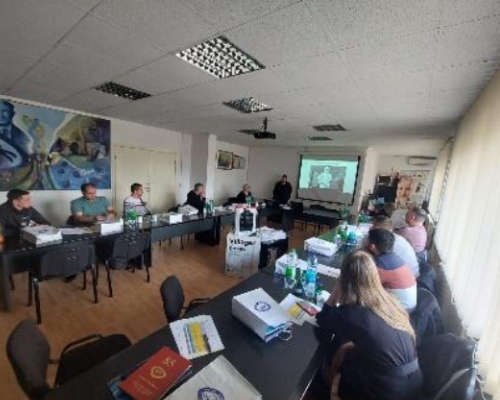
The trainings, through lectures and interactive workshops, broadly covered the following areas:
познавања прописа из DDDD, као и неопходне вјештине и знања у пружању ових услуга из области ветеринарске медицине. Едукације су једнодневне, а учесници по завршетку добијају сертификат о стручном оспособљавању за обављање послова DDDD у ветеринарству.
Дијагностика трихинелозе
The International Commission on Trichinosis has recommended that all laboratories that examine samples of pork, meat of other animals and game for Trichinella larvae be included in the quality assurance system for examinations, in the same way as EU member states, because achieving the reliability of the findings of each individual laboratory is ensured only by introducing the ISO 17025 laboratory standard, so the introduction of this international standard for testing laboratories, according to the new food safety regulations, is an obligation for every testing laboratory. However, in some endemic areas of the Balkans and Eastern Europe, due to cultural specificities, pig slaughter outside slaughterhouses (in households) is common, where owners are referred to meat testing laboratories for Trichinella larvae, within local veterinary organizations, for which ISO 17025 accreditation is too expensive. In order to make this service accessible to the population, even EU regulations have made a derogation, or exception, from the obligation of accreditation for Trichinella testing laboratories within veterinary organizations and small slaughterhouses (EU Regulation 2016/1843), but with the condition that their staff receive additional education and participate in accuracy and professionalism testing, organized by the national reference laboratory for trichinosis. This derogation was initially temporary, and has been permanent since December 2019 (EU Regulation 2017/625, Article 40(1)(a)).
The requirement for the competence of testing laboratories for meat control for Trichinella larvae has been taken over in the Republika Srpska and Bosnia and Herzegovina by the Regulation on measures for the suppression and eradication of animal trichinosis (Official Gazette of the Republika Srpska 44/10) and the Regulation on the method of conducting searches for the presence of Trichinella in meat (Official Gazette of BiH 56/11, 4/13), which stipulates that, as of 01.01.2013, veterinary organizations that test samples for the presence of Trichinella larvae in meat must be appropriately trained and regularly participate in the quality control program for testing samples. For this reason, VIRSVB, as the reference laboratory for trichinosis in the Republika Srpska, holds training sessions for veterinary doctors who test meat for Trichinella larvae, in accordance with the above regulations and the real need for veterinary doctors from laboratories that test meat for Trichinella in veterinary organizations and slaughterhouses in the Republika Srpska to be additionally educated about various testing methods, critical points of these methods, and the risks they should pay attention to, entering into a binding relationship with clients from whom they take meat samples that were not sampled by professional and trusted persons. The training has been organized once a year since 2013.
Food business entities
VIRSVB organizes educational meetings as a form of good practice in communication with users of laboratory services (food business entities, veterinary and food inspection). In this way, legal regulations in the field of food safety, methods are explained.
testing, sampling methods, method of sending samples to the laboratory, method of presenting and interpreting laboratory test results, measurement uncertainty, declarations of conformity, decision-making rules, etc.). Several such trainings have been organized so far, of which, in terms of interest and relevance, the most significant is on the topic of microbiological criteria in food.
Seminar for veterinary knowledge innovation
As a sponsor that financially supports the educational event, VIRSVB provides support in the organization of the Seminar for Innovations in Veterinary Knowledge, which is held every year by the Faculty of Veterinary Medicine, University of Belgrade.
The seminar is one-day, and is held through invited lectures and thematic workshops in the fields of animal health protection, clinics, obstetrics, surgery, food safety, etc. So far, 45 of these educational gatherings have been held.
Agrores
VIRSVV staff has been participating in the Agrores scientific conference for years, presenting scientific papers, and since 2024, VIRSVB has been a co-organizer of this scientific conference. The Agrores scientific conference, as an international scientific symposium of agricultural sciences, is organized by the Faculty of Agriculture of the University of Banja Luka and 15 other domestic and foreign institutions and organizations. This scientific conference has been traditionally held in Trebinje for years and covers the following thematic areas: crop production, horticulture, animal production, agrarian economics and rural development.

Contact
Banja Luka
Address: Branka Radicevica 18
Contact
Bijeljina
Address: Industrial Zone 2

