
Wild boar
1. Notification on the need for surveillance of fascioloidosis in wild deer in the Republika Srpska
You can download the notification on the need for fascioliasis surveillance here.
Current activities
The Veterinary Institute of the Republika Srpska "Dr Vaso Butozan" carries out the following activities related to the monitoring and protection of wild animal health:
- regular surveillance of fox rabies;
- редовни надзор над класичном кугом код дивљих свиња;
- regular surveillance of trichinellosis in wild boars and
- regular monitoring of fox trichinosis.
The Veterinary Institute "Dr Vaso Butozan" Banja Luka is part of the action "Oral vaccination of foxes against rabies in Bosnia and Herzegovina" where the success of oral vaccination of wild animals in Bosnia and Herzegovina is monitored, and the ultimate goal of the project itself is to reduce the occurrence of diseases in wild animals. The laboratory of the Veterinary Institute "Dr. Vaso Butozan" in Banja Luka has accredited the TFA method for diagnosing rabies, i.e. proving the virus in nervous tissue. Read more about oral vaccination of foxes and rabies here.
2. Testing for parasitic diseases of wild boars and chamois in hunting grounds of the Republika Srpska
The Hunting Association of the Republic of Srpska and the Veterinary Institute of the Republic of Srpska "Dr Vaso Butozan" Banja Luka, based on the signed cooperation agreement, conducted an examination for the presence of parasitic species of wild boar and chamois in the hunting grounds of the Republic of Srpska. This examination was designed based on the experiences of European countries. The examination included: examination of feces of wild boars and chamois caught in the hunting grounds of the Republic of Srpska and pathomorphological examination of organs for the presence of certain parasitic species.
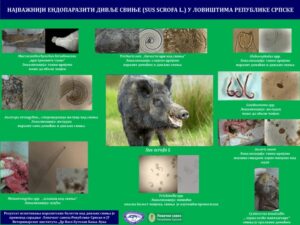
Based on coprological examinations of fecal samples from wild boars, the following parasitic elements were identified: stork eggs Metastrongylus spp., gastrointestinal strongylid eggs, eggs of the species Ascaris suum, eggs of the species Gnathostoma hispidum, spirocercid eggs, stork eggs Capillaria spp., eggs of the species Trichuris suis and coccidia oocysts. Approximately 75 samples from shot wild boars, as well as four chamois, were examined.
Pathomorphological examination of the organs of wild caught animals revealed the following parasites: Macracanthorhynchus hirudinaceus, Ascarops strongylina, Physocephalus sexalatus, Globocephalus spp., Metastrongylus spp., Trichuris suis and Cysticercus tenucollisThe most abundant species were Metastrongylus spp. and Trichuris suisOther parasites were found in a smaller number of the examined sample (Cysticercus tenucollis, Gnathostoma hispidum, Ascarops strongylina, Physocephalus sexalatus).
Based on the obtained results of parasitological examinations, we conclude the following:
- Wild boars in the territory of the Republika Srpska hunting grounds are hosts to a large number of parasites, some of which are significant for human health;
- The most important parasite for the health of wild boars is Metastrongylus which is widespread in most hunting grounds of the Republika Srpska.,
- Wild boars are sources of infection for domestic pigs kept on pastures in certain parts of the Republika Srpska,
- Oral deworming of wild boars in closed hunting farms where a known number of wild boars is present is recommended,
- It is recommended that the entrails of captured pigs be harmlessly removed after they have been removed by hunters;
- Lungs must not be used for human or animal consumption until they have been examined for the presence of Metastrongylus and
- Continue surveillance of parasitic diseases in game animals.
Also, as part of this activity, four chamois were examined for endo- and ectoparasites from the municipalities of Foča and Višegrad. The following parasites were detected: intestinal and abomasal strongylides (Haemonchus spp., Ostertagia spp., Marshallagia spp., Trichostrongylus spp. Nematodirus spp.), , Моniezia spp., Protostrongylidae and Еimeria spp. Oд ектопаразита су утврђене сљедеће врсте и родови: Ixodes ricinus, Haemaphysalis spp. и Lipoptena cervi.
Sampling of chamois organs was carried out by the expert service of the Veterinary Institute. An obvious health problem in chamois is protostrongylids (lungworms) and abomasal nematode. H. contortus.

3. Salmonella enterica subsp. Diarizonae from clinical material of a badger, Meles meles, from Bosnia and Herzegovina: phenotypic and molecular characterization
We believe that the work of the group of authors presented at the annual Conference of Veterinarians of the Republic of Srpska, 2020, (online presentation, ZOOM format) presented here as an abstract and in pdf. PowerPoint format, can be useful to everyone who is directly or indirectly involved in the area of risk awareness as well as the method of controlling the recognized risk that a proven biological agent carries with it.
You can view the work. here
Salmonella enterica subsp. diarizonae from clinical badger material, Meles meles, из Босне и Херцеговине: фенотипска и молекуларна карактеризација.
Violeta Santrac, Sara Petrin, Alessia Tiengo, Marta Leati, Massimiliano Orsini, Veronica Cibin
Keywords: Salmonella, Bosnia and Herzegovina, badger, WGS
In this abstract, we describe the application of gene-based analytical techniques in the typing of a rare Salmonella strain isolated in VIRSVB.
Gender Salmonella consists of two types, S. enterica and S. bongori. S. enterica is divided into six subspecies: enterica (I), salamae (II), arizonae (IIIa), diarizonae (IIIb), houtenae (IV), and indica (VI) and with limited laboratory capacity, it is not easy to fully prove the isolated strains and perform all the necessary tests to finalize the diagnostic results.
It is isolated. Salmonella spp from the liver of a dead badger from the Manjača plateau (N 44º41’1.91″; E 17º05’1.75″) near Banja Luka. The first clinical and phenotypic analyses were performed in the VIRSVB laboratory, accredited for the isolation of Salmonella. The isolated bacterium was confirmed as Salmonella spp. Later, the API 20 E biochemical test allowed the classification of the isolates as Salmonella enterica subsp. arizona. RT PCR је урађен како би се потврдио род Salmonella. Да би се идентификовао серовар, антигена формула је процјењивана тестом аглутинације, али је због недостатка специфичних серума за аглутинацију тест дао непотпуне резултате.
We took advantage of the opportunity of laboratory cooperation with the OIE/Italian NRL-Salmonella laboratory Istituto Zooprofilattico Sperimentale delle Venezie, where both phenotypic and genotypic characteristics of the isolates were analyzed. Regarding phenotypic analysis, biochemical tests and identification of somatic and flagellar antigens by agglutination test were performed. Whole genome sequencing (WGS) was performed using the Illumina platform NextSeq 550; The obtained data were analyzed using two different software tools: SpeciesFinder and KmerFinder
Combining the results of the performed analyses, the test isolate was proven to be S. diarizonae with the following antigenic formula: 17:z10:e,n,x,z15.
Salmonella enterica subsp. diarizonae can be isolated from environmental samples, reptiles, sheep and humans, with a possible potential for environmental contamination as yet unknown.
The result draws attention to possible infections in wild animals and exposure of humans who traditionally use meat and organs badgerThis result enriches part of the One Health concept, and the information presented can serve the public health service.
As far as we know, this is the first finding Salmonella enterica subsp. diarizonae код европског јазавца, из Босне и Херцеговине